FRIDGE MAGNETS: NOT JUST COOL DECORATION

Refrigerator magnets come in all shapes and sizes and for all purposes.  Most are for decoration or advertising.

I have used these business card magnets for years, but for a slightly different purpose.  I have a Functional Needs  child (aka Developmentally Disabled, Special Needs, Handicapped (terms keep changing to stress a more positive and empowering connotation).  My daughter has had medical emergencies during times I was home and when I was not.  Everyone knows that Mom is the go to for information on her family.  Moms usually have all the contact info for each family member and is knowledgeable of each family member’s medications, medical conditions, allergies, daily schedule, location, and physician information.  What if Mom is not home?  What if you have called and her phone is dead or off because she is in a meeting.  Then what do you do?

You can buy these at most office supply stores

You can buy these at most office supply stores

Put the information that might be needed in an emergency in an easily accessible place.  The Fridge.

This helps reduce calls to mom from family members (from the kids who want a pizza!) for mundane things as well as for Emergencies when mom can’t be reached right away.

We include whatever is a frequent informational need (such as pizza, takeout etc), as well as emergency repair people (plumber, A/C, utilities, tow services, frequently visited businesses and more).
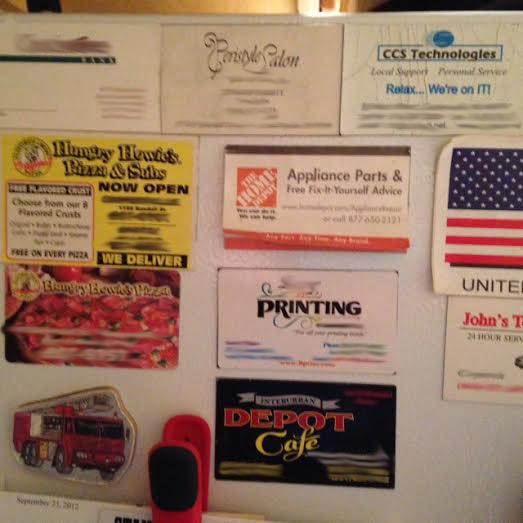
Frequently Used Services (gotta have pizza!)

Frequently Used Services
(gotta have pizza!)

WE ALSO HAVE IMPORTANT MEDICAL EMERGENCY CONTACT CARDS (Dr’.s Business cards).  These include my daughter’s Pediatrician, Neurologist, Dentist and any other important information.  As a mom, I am the most frequent user of these items and it saves time digging for a number from a phone book, Google (yes, its faster than Google if you are in fridge vicinity, sorry Google), or something stored in a phone (under Dr. Who? What?).

It has also been helpful to a caregiver (babysitter, family, friend) who maybe had to look at MY BUSINESS CARD to get my work phone number in an emergency.

You may not want to cover your fridge in such things if you are a purist, or dislike clutter, but It has been helpful to us for many reasons. You can organize the magnets on one hidden side, or give a panel or section to each family member.  Kids love to have their own areas to hang artwork too.

Business or Emergency Information (Physician information can be helpful to other family members or even a babysitter in an emergency when Dad or Mom are not available)

Business or Emergency Information
(Physician information can be helpful to other family members or even a babysitter in an emergency when Dad or Mom are not available)

You can use the same concept in your office if you have file cabinets, note boards etc.  However, I must warn you not to place magnets on computer cabinets, near your devices, cell phones, or in your purse next to your credit cards.  Doing so could have detrimental results!!

Most computer nerds know this.  Yes, my husband calls me a nerd because of the extensive amounts of useless knowledge that stores itself in my melon, but I posit that it comes in handy sometimes!

Here’s more info on why you should not put magnets on your devices: http://www.apexmagnets.com/news-how-tos/magnet-safety-technology-that-you-should-never-put-near-high-powered-magnets/

Hopefully this tip can streamline your in home emergency and frequently used phone numbers or contacts.  If nothing else it will reduce the number of phone calls from your teenagers asking you for phone numbers for the Pizza Place.

Technology in Project Management

The use of technology in project management is nothing new, but it has changed.  It started with the wall calendar, now we have Google calendar.  Deadlines for projects were all hard copy, and group meetings and collaborations occurred in person.   All business was done in person or over the phone.  Then came the internet, email and social media technologies.  Now some have the option of working remotely, from home or from vacation spots.

I use technology from home for our family business, although I feel the need to make personal visits to find out first-hand what is happening in real time and to be able to take pictures.  Sometimes, I do not get the information I need unless I make a personal visit.  We seem to get the most attention and hits from this photographic eye candy.   It is easier for me to take photos and post them than to have someone else do it.  I know what I want and what need and am fairly good with the aesthetics of taking photos.  Asking someone else do it when they do not have time to do it puts extra stress on them during a usually busy day.

I really like technology and enjoy working from home.  I do not like tech tracking, GPS, or location services.  I feel that sometimes these tools can be misused and for personal safety reasons, I sometimes prefer to turn off location services on my tech devices.  I really do not want technology to become a substitute for personal contact.  It is already annoying to go out to dinner or socialize with family and find that everyone is on their devices and people have forgotten the art of conversation.  Oh the price of progress.  At least we have not resorted to contact-free sex as depicted in the 1993 movie, Demolition man…yet.

Padmasree Warrior, who works for Cisco as their chief technology officer points out that, “A fundamental requirement for collaboration is communication.  Technology can aid this by providing platforms to disclose what people are working on and thinking about (Schaffner, 2010, January 20).  Lack of communication is what causes misunderstandings, disagreements, and final projects that do not fulfill the needs of the client.  The use of technology has changed and facilitated an increase in communications in and between organizations as well as subcontracted individuals and companies.

“Google docs” has been widely used by students collaborating on reports and presentations for college classes.  This makes it easier for everyone in the group to contribute without having to meet.  For many college students with busy schedules, getting the whole group together for group projects can sometimes be impossible.

Mike Isaac, of the New York Times, wrote an article discussing “Facebook@Work” purported to be the next collaboration tool for business, which “will allow users to collaborate on projects through group chats and document collaboration with co-workers…”(2014, November 17).  In 2014, the 7th International Conference on Collaboration and Technology took place in Santiago, Chile.  The Conference served as a “showcase” for new and emerging tech and its uses for improving collaboration (http://www.collabtech.org/).

Collaboration is something college students do.  The new small business and social media enterprise has led to the increase in working, blogging and advertising from home.  Personally, this saves me a lot of time.  I look forward to the day we do not actually have to go to class to listen to the lecture or to learn.  That would be great for me, a very busy person, but it requires one to keep on top of the schedule and be a self-starter.

What does this mean for the future?  It could lead to project collaboration occurring from points across the globe, from home, from vacation and getting experts in different aspects of a project together can sometimes be problematic.  Working on things remotely could solve a lot of logistical problems.  Realistically a project could be worked on around the clock in different stages.  This would save travel time and costs.  Realistically it could save organizations money on the purchase of real estate.  The office building as we know it could become obsolete.  Now that would be interesting.


References

http://www.collabtech.org/

Isaac, M. (2014, November 17). Facebook testing collaboration tools for businesses.  The New York Times.  Retrieved from http://bits.blogs.nytimes.com/2014/11/17/facebook-prepares-a-business-product/

Schaffner, M. (2010, Jan, 20).  How technology enhances collaboration.  Forbes.  Retrieved from http://www.forbes.com/2010/01/19/collaboration-cisco-software-technology-cio-network-schaffner.html

Social Media Love it or Hate it – After words

This is a follow-up to my post “Social Media Love it or Hate it post”.

I stated that I love Social Media.  I need to clarify that.  I love some social media platforms, but not all of them.  Since taking Technology & PR in Advertising, I have learned to be more proficient on several platforms but have also learned that I have a tendency to dislike platforms that are not fast and easy or that I have to pay for.  If I am unable to see what it is and how it works before I pay for it I will not take a chance.

I am very busy with family, several jobs, and school.  I also do some volunteer and pro-bono work, and am working on a book.  I really cannot  afford time-wasters, but need certain tools for some of what I do. Therefore, I am choosy about what I use because of the purpose or need.  If I do not have the need for a particular app or platform then it is useless to me.  I have learned that I need time in order to become proficient.  I also feel that for security, and safety purposes being proficient, especially when it comes to privacy settings is important.

There are the sites promising you 6 tips for better social media marketing, pay by Paypal, credit card etc. I guess everyone wants to make a buck selling their knowledge and experience.  There is nothing wrong with that, but you need to know what you are getting in return for your money.  If One wants to learn how to use a social media platform or learn things like this, it is so much cheaper to figure it out, Google it, or follow a tutorial.  Again, self-teaching or even taking a class takes time.

Be choosy.  Why?  The newest looking App or platform may look great in the description, but once you download it, does it mine your personal data?  If so, for what purpose?  Not only that, if there is a problem it is difficult to complain without a physical presence or email or phone number.  The established platforms have been tested, modified, and tested again. This helps to establish reliability.  I like that.

According to WHSV News there are apps that kids can download and easily sign up for that allow for a text conversation where the data is erased when the discussion is over.  There have been increases in police reports because some are being used to solicit for sex.  It is nearly impossible to find out afterwards where the text came from (Galvez, 2014).

The other annoying thing I have noticed is that apps or games I used to play or use often are now being commercialized. Advertisements pop-up in them (SO ANNOYING!).  Maired Ridge warns that, “This holiday season, brace yourself for a new paradigm in social marketing-one that values sales over status updates and commerce over engagement” (Ridge, 2014, November 9).  I think if this happens there may be push back from users who do not want to make purchases through the apps or over their cellphones and do not want their gaming activities interrupted. Unless an app has been around for a while, is tested and I do not hear of any big problems with it, then I might be tempted to use it, but not likely.  Those of us who value our resources and want to protect our identities and wallets may not jump on the bandwagon as quickly as others do.

After taking this class, I do not think my opinion has changed much on Social Media.  I think it is still a matter of choice, preference, and using the proper tool for any particular purpose.  I have learned that there are some things I am not very good at, there are some things I can muddle through, and there are others things that I do very well.  I will always seek to improve my skills and try to stay on top of current trends, but again that would mean I would have to set aside time for that.  I think it all boils down to priorities.

References

Galvez, S. (2014, November 11). Police see increase in calls over social media apps [news broadcast]. Harrisburg, Pennsylvanie: WHSV TV. Retrieved from http://www.whsv.com/home/headlines/Police-See-Increase-in–282246341.html

Ridge, M. (2014, November 9). Forget engagement: This holiday season, social media is all about getting people to buy. Retrieved from: http://venturebeat.com/2014/11/09/forget-engagement-this-holiday-season-social-media-is-all-about-getting-people-to-buy/

Social Media-Love it or Hate it?

Social Media.  Some people love it and some people hate it.  I love it, but have to be careful that it does not consume too much of my time when I should be doing something else.  I use WordPress, Facebook, Twitter, Linked In, YouTube, and Pinterest and am exploring other social media platforms.

I use social media to promote me and to advertise our family business. I have used it for investigative purposes (Yes, this happens). It’s free, convenient, mobile, and fairly easy to use.  If I am not sure how to use a social media platform, it is easy to find tutorials on YouTube.  Social media can be used for informing the public, emergency preparedness and response, personal preparedness education as well as publicizing disaster preparedness tips.

These days almost everyone has a smart phone.  Even if power goes out if you have a charge on your phone you can get real time information through social media.  “According to a recent study by the American Red Cross, citizens are now seeking out and utilizing social media to send and receive information” (Crowe, 2010, pp 416).  Emergency management officials can also monitor social media to gather information (Fema and crowdsourcing) to narrow down areas needing response more quickly among other things.

Social media has also become a two-way communication tool for informational and public relations purposes.  Jonathan Walters discusses social media as a public relations tool: “One agency that’s been held up as a national model for using social media in a sophisticated way is the Palo Alto, Calif., Police Department—not for crisis response, although it’s ready to use if necessary—but for day-to-day community relations and general citizen goodwill building” (2014, p.46).  YouTube has become not only a vehicle for entertainment but for learning (through tutorials), advertising, and public service messages.  One of my favorites public service announcement is by the American Heart Association, is of Ken Jeong demonstrating AHA Hands-Only CPR.

There are many benefits and positive applications for the use of various social media platforms, but there can be problems with misuse. According to Bill Keller, “The most obvious drawback of social media is that they are aggressive distractions” (2011). There have also been many instances of bullying, harassing, and malicious uses of social media.

Children and teenagers are by nature impulsive and should be supervised, educated and their social media use monitored, or followed by parents.  Parents need to watch to be sure their children are being responsible, to see if they are sharing too much information.  If a parent finds hurtful or malicious messages are being exchanged, intervention by an adult should be immediate and is crucial!  In fact, I believe that parents as well as schools need to do a better job educating kids about bullying, responsibility, and self-control.  Some of this is already happening due to suicides of children who have been bullied and the concern over personal information or pictures being posted resulting in criminal charges.

In conclusion, social media is here to stay, love it or hate it.  If you choose to use it, it would be wise to re-read what you are about to post and think about how someone else could perceive the message.  If you do not like drama, you can choose who to follow and who can appear in your feed.  Make sure you review your privacy settings, and realize once it is posted you cannot take it back. When it comes to intent, teasing and sarcasm can sometimes be lost in translation due to lack of social cues (or body language and expression).  If you can self-edit, and explore the many benefits of social media you can find there are so many possibilities for its use now and in the future.

References

Crowe, A. (2010). The social media manifesto: A comprehensive review of the impact of social media on emergency management. Journal of Business Continuity & Emergency Planning, 5(1), 409-420. Retrieved from http://ieeexplore.ieee.org.ezproxy.gvsu.edu/stamp/stamp.jsp?tp=&arnumber=6758847

Keller, B. (2011, May 22). THE TWITTER TRAP.  New York Times Magazine, 11-12. Retrieved from http://search.proquest.com.ezproxy.gvsu.edu/docview/868717162?accountid=39473

Walters, J. (2014, July). Lost in translation: governments are still struggling to get social media right. Governing, 27(10), 46+. Retrieved from http://go.galegroup.com/ps/i.do?id=GALE%7CA374922239&v=2.1&u=lom_gvalleysu&it=r&p=AONE&sw=w&asid=04cfc9234e12e6504d385c6a3bba4e2b

COULD ARTPRIZE IMPROVE ITS USE OF TECHNOLOGY?

ArtPrize 2014 18 ArtPrize 2014 15

This is a follow-up to my first post about ArtPrize.  I tried to contact ArtPrize staff to find out more about the technology for the first blog, but never got a response.  This IS understandable because it was during the event and everyone was probably extremely busy.

Personally, I was a little disappointed this year.  There seemed to be less entries, more traffic, and a number of entries were not installed until late into the event.  There were “performance artists” on various street corners.  It was difficult to tell whether they were actually an ArtPrize entry or individuals just capitalizing on the event.  I suspect it was the latter. Then, there were the problems with the ArtPrize voting app.

It was reported that the voting app got bogged down with heavy traffic and was running very slowly.  During my visit one entrant told me that someone had voted for his entry but the vote went to another entry.  The artist told me that the occurrence was reported to ArtPrize, but it is unknown to me what happened or how it was remedied.

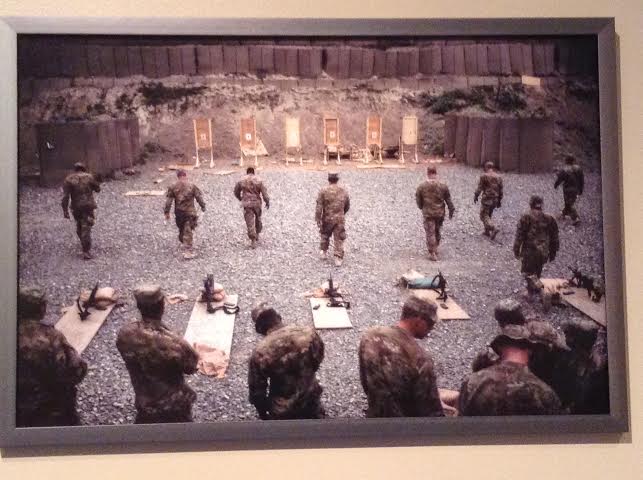
In spite of the technology glitches that occurred during ArtPrize, I agree with the results, although I would have liked to see one of my favorites in the finals (Ryan Spencer Reed).  The photos in this post are of his installation.  I think maybe the installation was too raw for some, thought-provoking, and in some ways dangerous.  “Despite Similarities to Reality, This is a Work of Fiction” by Ryan Spencer Reed held my usually short-attention span for a long time.  I was unable to talk to Reed but I did speak with “Photographic Mentor” Charles Clark, who assisted Reed with editing and writing.  I found Clark very sincere and interesting and spoke to him at length.  He told me that the photos were taken by Reed as an imbedded photojournalist in Afghanistan.  They show much more than the American people have been allowed to see, yet they were careful to be respectful.  Clark believes the government has limited the amount of information that is available to the American people.

It was interesting that although there were problems and glitches with the technology used during ArtPrize, very little was said about it by the media.  During day one of ArtPrize I was unable to get the voting app installed on my phone, and in fact my phone battery died after trying several times.  I eventually got it, but too late for it to be useful for my visit.

Wood Tv8 reported that Todd Herring, Director of Communications for ArtPrize, “said that voting on the app is down 21% while voting by text is up 15%” (Wood Tv8, October 2, 2014).  It was good planning on the part of ArtPrize to have more than one method of voting, but frustrating for those who were not aware of the text option.  This was the only mention I could find aside from some blog posts that there was a problem.  I checked Twitter for any chirps about the technology issue but did not find anything.  Why was there so little information on the glitches?  Was it due to the fact that media has partnered with ArtPrize to support the event in the community and did not want to risk offending the organizers? Could it be they are more understanding of ArtPrize’s growing pains due to the perceived benefit to the local economy and community?  Since its inception ArtPrize has been interesting, novel and innovative.  It may be that the novelty is waning, and some are feeling it is getting away from art and heading towards commercialization.

Artist Anna Lisa Schneider parodies ArtPrize with her “FartPrize” entry.  She describes her work as “a tongue-in-cheek, visual exploration of the entire ArtPrize experience.”  Schneider feels that many entries in ArtPrize are directed at a conservative West Michigan, but admits the event makes her “…giddy to have an entire city become a giant gallery for three weeks” (Fisher, 2014).  Schneider also points out that artists who want to participate in the event take a financial risk.  It costs money to enter, create, and participate with small chance of being a winner.  This brings new meaning to the term “starving artist.”

ArtPrize continues to evolve and make improvements.  I have no idea the amount of work it must be for the organizers, sponsors and artists and therefore have no basis for criticism.  I think overall the glitches have been small (or not publicized) and response from the public has been overwhelmingly positive.  There have been negative responses, but even those affirm the overall concept of ArtPrize to facilitate dialogue about art.  ArtPrize will no doubt improve its use of technology. and continue engagement with  the community through social media like Twitter and Facebook and its ArtPrize app.  The biggest challenge will be for ArtPrize to continue to attract artists without unintentionally limiting entrants to those who can afford it.

References


Fisher, V. (2014, October 2). Artist caricatures ArtPrize, West Michigan, fellow artists with exhibit “FartPrize. The Rapidian. Retrieved from http://therapidian.org/artprize-spotlight-fartprize

Woodtv.com. (2014, October 2). ArtPrize blames sluggish app for fewer votes. Wood Tv8. Retrieved from http://woodtv.com/2014/10/02/artprize-blames-sluggish-app-for-fewer-votes/

THE ROLE OF TECHNOLOGY IN ARTPRIZE

Ryan Spencer Reed

Ryan Spencer Reed

During my lifetime, the continuing evolution of electronics and many other processes leads me to believe that technology changes everything. In my public safety experiences, I have noticed that as we learn and produce new things, our standard of living changes, new terminology appears, there are new types of cyber-crime and more creative criminals; This results in new laws to address the evolution of crime and criminality. Technology has touched everything and everyone in some way (even those who avoid it). Technology has also changed art in so many ways. What exactly is “art” anyway? It really depends on who you ask.

The Stanford Encyclopedia of Philosophy devotes almost 15 pages to the definition of art. These definitions discuss “traditional”, “historical”, “conventional”, “functional” and “contemporary” definitions as well as ideologies and their influence on defining art (“Art,” 2012).  There are as many definitions for art as there are criminological theories. Defining things that change and evolve is like trying to hit a moving target, difficult at best.

Immanuel Kant is cited frequently in Criminal Justice for his theories. Kant’s definition of art is: “a kind of representation that is purposive in itself and, though without an end, nevertheless promotes the cultivation of the mental powers for sociable communication” (Kant, Critique of Judgment, Guyer translation, section 44). I define art as a single or multi-media conglomeration or representation that elicits an emotional response from the creator and the viewer.

Since the inception of ArtPrize in 2009 it has been the goal to use technology in order to draw a younger audience to the arts. In the 2009 press release for ArtPrize, Rick Devos said, “It’s time to reboot the conversation between artists and the public. ArtPrize will be a celebration of art, design, and innovation that will bring artists and the public together like never before” (ArtPrize, 2009).  The ArtPrize 2013 Annual Report also describes technology used for the event, and reports that, “ARTPRIZE HAS GIVEN GRAND RAPIDS FAR-REACHING BENEFITS INCLUDING ENRICHING ITS CULTURE, BUILDING AWARENESS OF THE REGION, AND BOOSTING ITS SOCIAL CAPITAL” (ArtPrize, 2013, p.18).

ArtPrize uses its website, along with mobile apps in order for the public to receive information, vote on their favorites, and voice their opinions and experiences on social media platforms (Smith, 2010, September 28). Volunteers at The Hub can monitor real-time social media streams (Smith, 2010, September 28). This gives ArtPrize staff information regarding what the public likes and does not like about their experience, which is useful for planning the next year’s ArtPrize (Smith, 2010, September 28).

Mlive reports that in 2014 ArtPrize released a whole new set of techno tools; “New tools include a feature to create lists of art to see, a feature to create a route to view them, and the ability to share both with others. Also new is an updated interactive map to help visitors explore more of the city of Grand Rapids beyond ArtPrize during the event…” (Kaczmarczyk, 2014, September 4). These tools aim to facilitate a more interactive experience with attendees and help them to find quickly art they want to see. Comcast is a technology sponsor for the event, providing voting “kiosks” and “roving mobile voting stations” this is helpful to those who do not use or have access to mobile apps (Kaczmarczyk, 2014, September 4).

Not only is technology playing a larger role in this community event, it is also playing a larger role in the actual art entries. Many artists have integrated various types of technology into their works. Some are statements about political or economic issues; others are just unique and interesting. Technology changes everything, even art.

References

ArtPrize. (2013). Curiosity rewarded. ArtPrize 2013 Annual Report. Retrieved from https://www.google.com/webhp?sourceid=chrome-instant&rlz=1C1_____enUS420US420&ion=1&espv=2&ie=UTF-8#q=curiosity%20rewarded%20artprize%202013%20annual%20report

ArtPrize Media Kit (2009) Retrieved from http://www.artprize.org/about/press/artprize-media-kits-reports

Kaczmarczyk, J. (2014, September 4). ArtPrize 2014: New tech tools will change how you experience the sixth event in Grand Rapids. MLive. Retrieved from http://www.mlive.com/artprize/index.ssf/2014/09/artprize_2014_new_tools_will_change_how_you_experience_the_sixth_event_in_grand_rapids.html

Kant, Immanuel, 2000, Critique of the Power of Judgment, trans. Paul Guyer and Eric Matthews. Cambridge: Cambridge University Press.

MARK W SMITH FREE,PRESS TECHNOLOGY. (2010, Sep 28). Click on ArtPrize. Detroit Free Press Retrieved from http://search.proquest.com.ezproxy.gvsu.edu/docview/755146777?accountid=39473

The Definition of Art. (2012). In Stanford Encyclopedia of Philosophy Retrieved from http://plato.stanford.edu/entries/art-definition

Continue reading

Where were you on 9-11?

Do you remember where you were and what you were doing on September 11th, 2001?

I was at work.

More specifically at sheriff department in the office of Bob S., polygraph examiner.

He was prepping to give a polygraph to an individual I suspected had embezzled money from his former employer.  Another person had been fired for it, but after interviewing everyone in that particular office I had it narrowed down to two people.  The person who was fired (to eliminate her) and the person who I thought was exhibiting body language that told me he was lying.

During the polygraph, the first plane hit.  We found out during a break.  We were glued to the tv set in the break room.  It was a room full of  utterly silent people, except for the news anchors commentary, even they couldn’t take it and  lapsed into silence from time-to time.  The pictures and video left little to the imagination.  We had to go back and do the rest of our job, finish the polygraph.  When we were done all hell had broken loose.  My suspect failed the polygraph and then admitted he had taken the money.

Our minds were on New York, then Washington DC, and the U.S.

When I got back to the office, no one was there except me.  I started calling family and friends to check on them.  My kids were safe.  I remembered the feeling in my stomach, sinking, sick, dread.

Later they were asking for volunteers to go to New York and help.  A number of people signed up, including me, but a “special unit” at the P.D. took it upon themselves to pack up and go.  One guy who came back from doing Critical Incident Stress Debriefing, said it was brutal, and he will never be the same.

I have had the opportunity to visit the 9-11 memorial in New York City.  It was and still is under construction.  The pools were finished.  It was an awe inspiring experience.  Even if you did not lose someone close to you, you could not help but to feel the stark utter anguish.  If you go, don’t be angry at yourself for the tears. NO ONE can keep them from falling.


Motorcycles and EMS

As a police officer and EMT, I have seen many types of accidents.  As a motorcyclist, seeing motorcycle accidents sometimes makes me consider giving up riding, but I enjoy it so much even though I don’t have time to ride often.

Here are some of my personal observations:

*     Riders who wear protective gear fare much better in single cycle accidents.

*     Riders who are hit by cars who wear protective gear fare better than those without but it doesn’t always make a difference depending on  speed and how the accident occurs.  Higher speeds means more severe injuries, no matter the vehicle.

*     If you don’t buckle your helmet securely under your chin, there is no point in wearing it; It will fly off in an accident.

*     Road rash is painful, takes a while to heal up and looks ghastly.

Driver’s of other vehicles, be aware that sometimes you may not see a cyclist.  Pay attention.

Motorcyclist, other drivers may not see you, always try to have options for avoidance.  Practice these techniques.  Pay attention.

Whatever your choice, to gear up or ride free…take into account weather, road conditions, time of day, where you plan on going before discarding safety gear altogether.

It is hard to tell if there has been a difference in fatalities since the helmet law in Michigan was overturned, the jury is out yet, and it depends on the study.  Either way, think about the impact you have on family, friends, EMS workers should something happen.  Drive safely, don’t do anything stupid.  This is in no way a recommendation to go with or without gear.  I am not knocking anyone’s individual choice.  It is your decision.  Me, I am not a very experienced rider so I wear the gear.  Some say , “Hey if I am gonna crash I might as well do it right and go all the way.  I don’t want to end up on life support.”

No matter what the reason for any crash, or the type of vehicle involved, we responders always carry with us the memories of those who didn’t make it and rejoice in those we are able save.

Here are some links to the debate that continues:

http://www.mlive.com/news/index.ssf/2013/03/did_michigans_helmet-choice_la.html

http://www.huffingtonpost.com/2013/05/30/michigan-motorcycle-injuries-helmet-law_n_3359586.html

http://www.abateofmichigan.org/HelmetLawInfo.htm

Click to access 2012MotorcycleStats.pdf

http://detroit.cbslocal.com/2013/04/10/impact-of-michigans-motorcycle-helmet-law-debated/


Special Needs and Emergencies

Another fact about me…I have a Special Needs Child.  What does that mean?  Well the terminology has changed due to negative connotations of educational and other types of labels.  There is an intensive hands on training that comes with this unique situation.

Rachael, had Spinal Meningitis when she was 2 weeks old.  I love her.  (Just so the other kids know, I love all my children; a bunch, whether biological, adopted, step or whatever.  Some don’t understand it yet, but when they have their own kids they will).

Rachael knows what love is even though Rachael has the cognitive level of a 3-4 year old (but she is 26).  She has Epilepsy, Cerebral Palsy, had brain surgery at age 16 which resulted in Left-sided Hemi-Paresis.  It saved her life.  And it changed her mobility.

In English?  Rachael had an illness at two weeks of age that resulted in brain damage that left her with muscle problems, and seizures.  When her seizures became worse (at the onset of puberty) and life threatening, brain surgery was the only option left.  At Cleveland Clinic they disconnected the two halves of her brain, the good from the bad (the damaged part), which stopped the electrical storms (seizures from the injured or bad part from interfering with her life, turning her into a zombie).  The surgery on the right side of her brain, affected the left side of her body (more on that in future posts).  But the trade off was worth it.  She can’t use her left arm but her life was saved and is so much better. She is present, happy, functional, her old self, no longer miserable, unhappy, feeling awful all the time.

If Rachael is sleeping, don’t even try to get her up (not a morning person!). If she’s outside, playing with toys, eating, and she wants to continue doing those things good luck!! Moving Rachael or trying to get her to go is sometimes akin to pushing a boulder uphill.  As her mother, I have always won these battles (I must!), but for someone else it is an entirely different matter.

So back to Special Needs (aka Functional Needs) and emergencies.  When mom (me) had to be at work there was a babysitter, or Home Health Aide, or family member.  One of the things about Rachael is, she won’t do what you want her to when you want her to do it.  And she can’t do stairs well.

So I was faced with the problem of being at work at night (or day) and there being an emergency that someone watching her might have to deal with.  What kind of emergencies?  In our neck of the woods, a house fire, tornado, storm, or something like that.  So I came up with a plan.  Bad storm or tornado, requiring a trip to the basement.  How to move a sleeping, uncooperative boulder to the basement?  Well we decided if she won’t get up the bedding would go with her.  It was safe and easy to take all the bedding with her on it, off the bed, dragged through the house and a cushioned bumping down the stairs (carpeted) to the safety of the finished basement where the other kids bedrooms are.  Now getting her back up would be my problem when I got home.  No big deal, for mom.

It is these things that parents of special needs kids need to think about.  When they are small you can pick them up and throw them over your shoulder if they have a temper tantrum, or you have to hurry for safety reasons to get somewhere.  When they grow up, it’s a whole different ball game.  You can’t spoil your special needs children, or coddle them.  They need to know what the rules and expectations are, because if you don’t spell that out early, it can be huge behavioral problems later.  Rachael expresses her own opinions and wants to be obstinate, but in the end she knows that Mom loves her, and for her, mom always wins.